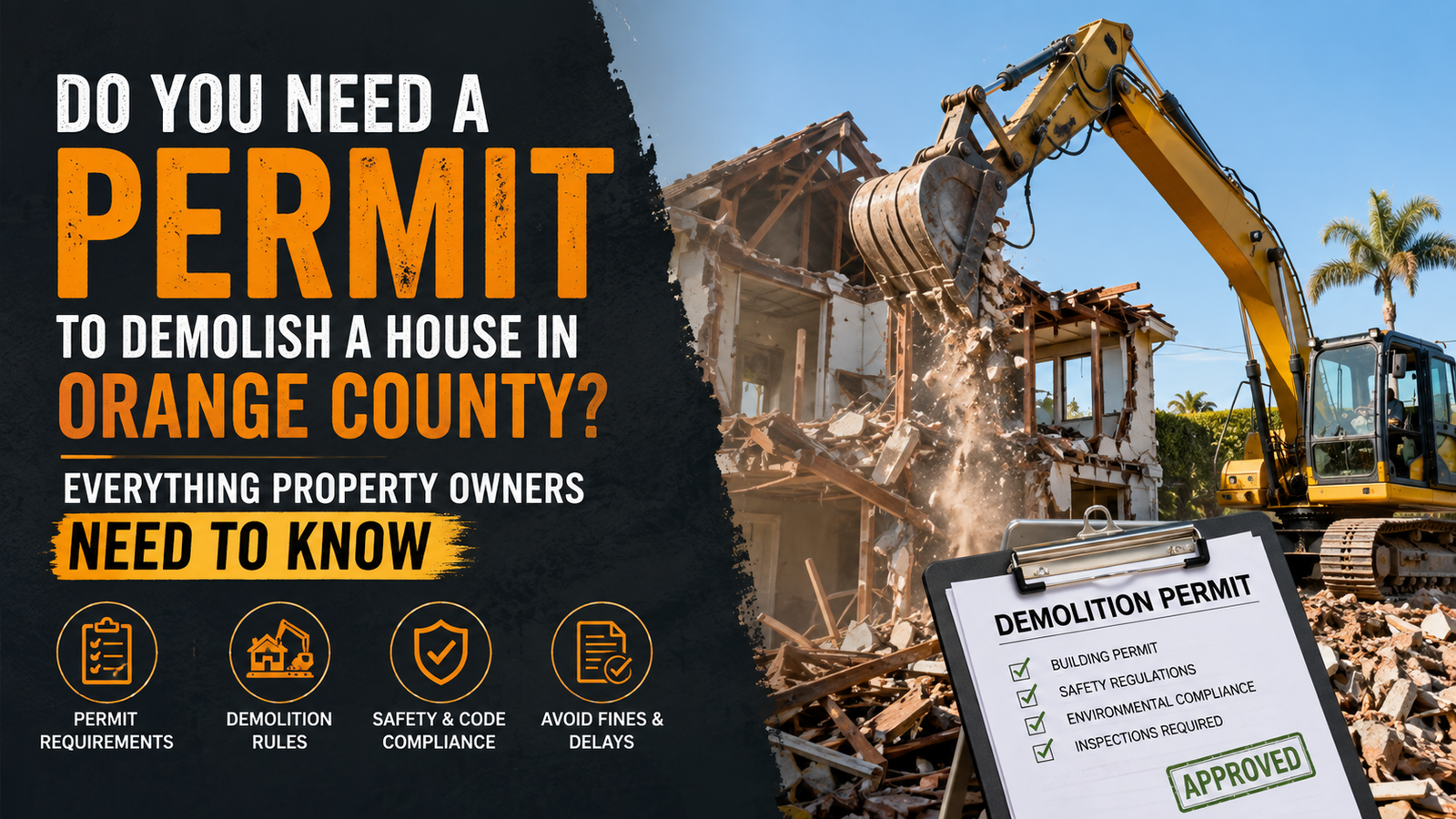

Demolishing a house in Orange County is a project that involves far more regulatory process than most property owners anticipate. The short answer to the question of whether you need a permit is unambiguous: yes, you do. Under California law and the building codes of every jurisdiction in Orange County whether you are in the unincorporated county area, the City of Anaheim, Irvine, Huntington Beach, Newport Beach, or any of the county’s 34 municipalities demolishing a structure requires obtaining a demolition permit before any work begins. This guide explains the full permit process, the required prerequisites, and what property owners across Orange County need to understand before proceeding with a House Demolition Orange County project.
The Legal Framework: Why Permits Are Required for House Demolition in California
California’s building permit requirement for demolition is grounded in multiple overlapping legal frameworks. The California Building Standards Code (Title 24 of the California Code of Regulations) establishes statewide minimum standards for construction and demolition. Every Orange County municipality adopts this code, typically with local amendments, through their individual municipal codes. The County of Orange’s Development Services Department and the building departments of each incorporated city are the local authorities responsible for permit issuance and enforcement.
Beyond the building code framework, California Health and Safety Code Section 19827.5 specifically addresses demolition permits: it requires that applicants either submit asbestos notifications to the South Coast Air Quality Management District (SCAQMD) or provide a declaration that the structure does not contain asbestos-containing materials. This statutory requirement reflects the serious public health concern associated with asbestos fiber release during demolition and makes environmental compliance an inseparable part of the permit process.
Working without a demolition permit in Orange County carries significant consequences. Unpermitted demolition work can result in stop-work orders, fines, and legal action from the relevant building authority. More practically, unpermitted demolition creates complications when the cleared property is sold or developed potential buyers, lenders, and their inspectors will identify the absence of a permit record for the demolition in the property’s history, which can complicate or block a sale. Rebuilding on a lot where unpermitted demolition occurred may require retroactive permits and inspections before new construction permits will be issued.
The Orange County Demolition Permit Process for Residential Structures
For residential demolitions in the unincorporated areas of Orange County, permit applications are processed through the OC Development Services Department. The FAQ published by Orange County’s Public Works Department is explicit: “You will need to bring four copies of a plot plan as well as an asbestos disclosure form in order for us to issue you a demolition permit. State law requires that a copy of each written asbestos notification be submitted to the South Coast Air Quality Management District (AQMD).”
For properties within incorporated cities which constitute most of Orange County’s residential areas the permit application goes to the city’s building department. Anaheim, Irvine, Santa Ana, Huntington Beach, Fullerton, Orange, and each of the county’s other cities have their own building departments with their own specific application procedures, fee schedules, and processing timelines. The requirements across jurisdictions are similar in substance all require documentation of the project scope, asbestos compliance, and utility disconnections but the specific forms, fee amounts, and processing times vary.
California demolition permits are typically valid for 180 days from the date of issuance. Work must begin within this 180-day window otherwise, the permit is considered expired and must be renewed. Once work commences within the permit period, the permit generally remains active as long as there is no lapse in work exceeding 180 days. Property owners planning demolitions should apply for permits well in advance of their planned project start date to account for processing time.
Prerequisites That Must Be Completed Before the Permit Is Issued
Step 1: Asbestos Survey and SCAQMD Notification
This is the most critical and most commonly misunderstood prerequisite in Orange County house demolition. Under the SCAQMD’s Rule 1403 which implements the EPA’s National Emission Standards for Hazardous Air Pollutants (NESHAP) for asbestos demolition of any structure requires either an asbestos survey by a certified inspector or a declaration that the structure does not contain asbestos-containing materials.
For any residential structure built before 1981, an asbestos survey by a AHERA-certified inspector is strongly recommended and typically required by the building department. Asbestos was used extensively in residential construction products through the late 1970s: floor tiles (particularly 9×9 inch vinyl composition tiles common in post-war construction), ceiling tiles, textured ceiling coatings (popcorn ceilings), pipe insulation, duct insulation, roofing felt, roofing shingles, and joint compound all commonly contained asbestos in Orange County’s substantial mid-century housing stock.
When the survey identifies regulated asbestos-containing materials, SCAQMD Rule 1403 requires that a written notification be submitted to the SCAQMD at least 10 working days before demolition or asbestos removal begins. This 10-day notification requirement is firm there is no mechanism to waive it for routine projects. The practical implication is that if asbestos is found, the demolition timeline must accommodate the notification waiting period before abatement can begin, and abatement must be completed before demolition proceeds.
A certified asbestos abatement contractor must perform the removal and disposal of any regulated materials. Abatement generates documentation manifest forms, waste shipment records, and completion notices that is typically required by the building department before the demolition permit will be finalized.
Step 2: Utility Disconnections
All utilities serving the structure must be properly disconnected and capped before any physical demolition begins. This requirement is both a safety necessity and a permit prerequisite. In Orange County, utility disconnections involve:
Southern California Gas Company (SoCalGas) for natural gas service the gas meter must be removed and the service line capped at the main. SoCalGas must confirm this disconnection in writing, and a copy of the confirmation is typically required for the permit application.
Southern California Edison or the relevant municipal utility (Anaheim Public Utilities, Brea, Fullerton, and several other Orange County cities operate their own electric utilities) for electric service the service must be disconnected at the meter, and the meter removed.
The local water utility (which may be the City, a special district like Moulton Niguel Water District, South Coast Water District, or Yorba Linda Water District, depending on the property’s location) for water and sewer service.
Telecommunications providers for landline, cable, and fiber service connections to the structure.
Written confirmation of each utility disconnection is required for the permit application in most Orange County jurisdictions. Property owners should initiate utility disconnection coordination at least four to six weeks before the planned demolition date to ensure all providers can complete their work in time.
Step 3: Plot Plan and Application Documentation
The demolition permit application requires a plot plan showing the property boundaries, the location and dimensions of the structure to be demolished, and any structures on the property that will remain. The plot plan allows the building department to confirm that the proposed demolition matches the permitted structure record and that any retained structures will not be adversely affected.
Additional documentation requirements vary by jurisdiction but typically include: the property owner’s authorization (or the contractor’s authorization under the property owner’s signature), proof of property ownership, the asbestos survey or disclosure, utility disconnection confirmations, and in some cases evidence of contractor licensing and insurance.
Who Can Perform Demolition Work in Orange County?
California requires that contractors performing demolition work including residential house demolition hold appropriate licensing from the Contractors State License Board (CSLB). The C-21 specialty contractor license (Building Moving/Demolition) specifically covers demolition work. General contractors holding a Class B license may also perform demolition as part of a broader construction scope.
California Business and Professions Code Section 7031 prohibits property owners from suing to recover for compensation under an unlicensed contractor’s work, and the CSLB enforces licensing requirements through its enforcement division. Property owners should verify any demolition contractor’s license status at the CSLB website (cslb.ca.gov) before engaging them. An unlicensed contractor creates significant liability for the property owner if injuries, property damage, or regulatory violations occur during the work.
Historic Structures and Additional Review in Orange County
Orange County contains a significant number of historically designated or historically eligible structures, particularly in the older established neighborhoods of Orange, Santa Ana, Fullerton, and along the historic corridors of Anaheim and other long-established cities. Demolition of a historically designated structure, or a structure that may be eligible for historic designation, triggers additional review that can significantly extend the permit process and in some cases result in denial of a demolition permit.
The State Historic Preservation Office (SHPO), the National Register of Historic Places, and local historic preservation ordinances all create potential layers of review for structures with historical significance. Property owners planning to demolish older structures in established Orange County neighborhoods should research the historical status of the property early in the planning process ideally before purchasing the property if demolition is the intended use to avoid discovering historical constraints after significant investment has been made in the project.
What Happens to the Site After House Demolition in Orange County?
The demolition permit process in Orange County includes post-demolition requirements as well as pre-demolition prerequisites. After the structure is demolished, the contractor must typically schedule a final inspection before the permit is closed. The inspection confirms that the structure has been properly removed, that no hazardous materials are exposed or unaddressed, and that the site has been left in an appropriate condition.
Many Orange County cities require that the cleared lot be graded to drain properly, that erosion control measures be installed if the site will remain vacant for any period, and that the site be maintained in a condition that does not become a nuisance through weed control, grading maintenance, and fencing if required. California’s stormwater requirements under NPDES Construction General Permit apply to disturbed sites above one acre, though local ordinances may extend similar requirements to smaller parcels.
Foundation removal is a separate consideration. When the intent is to immediately replace the demolished structure with new construction, the existing foundation must typically be completely removed and the site subgrade properly prepared for the new foundation system. Simply building over an existing foundation raises significant structural and building code concerns.
Common Questions About House Demolition Permits in Orange County
How long does it take to get a demolition permit in Orange County? For straightforward residential demolitions without historic designation concerns, permit processing typically takes two to four weeks from complete application submission. Applications requiring asbestos abatement coordination add time the 10-working-day SCAQMD notification waiting period alone adds two calendar weeks to the minimum timeline before demolition can begin.
Can I start the asbestos survey while waiting for the permit? Yes, and this is standard practice. The asbestos survey should be initiated as early as possible in the process ideally before the permit application is submitted because the survey results are needed for the application and because the survey timeline (physical inspection plus laboratory analysis of samples) adds one to two weeks to the process independently of permit processing time.
What if my house doesn’t have asbestos? Even if you believe your house does not contain asbestos, the permit process requires either a declaration to that effect (typically only appropriate for structures built after 1981) or a certified inspector’s survey confirming its absence. For any structure with uncertainty about its construction period or materials, the survey is the appropriate approach to avoid regulatory liability.
How much debris is generated by a typical house demolition in Orange County? A typical 1,500 to 2,500 square foot single-family home generates approximately 50 to 100 tons of demolition debris concrete from the foundation, wood framing, roofing material, and general construction debris. Most Orange County demolition contractors haul this material to recycling and disposal facilities in the Inland Empire and throughout Southern California, with concrete typically recycled as crushed aggregate.